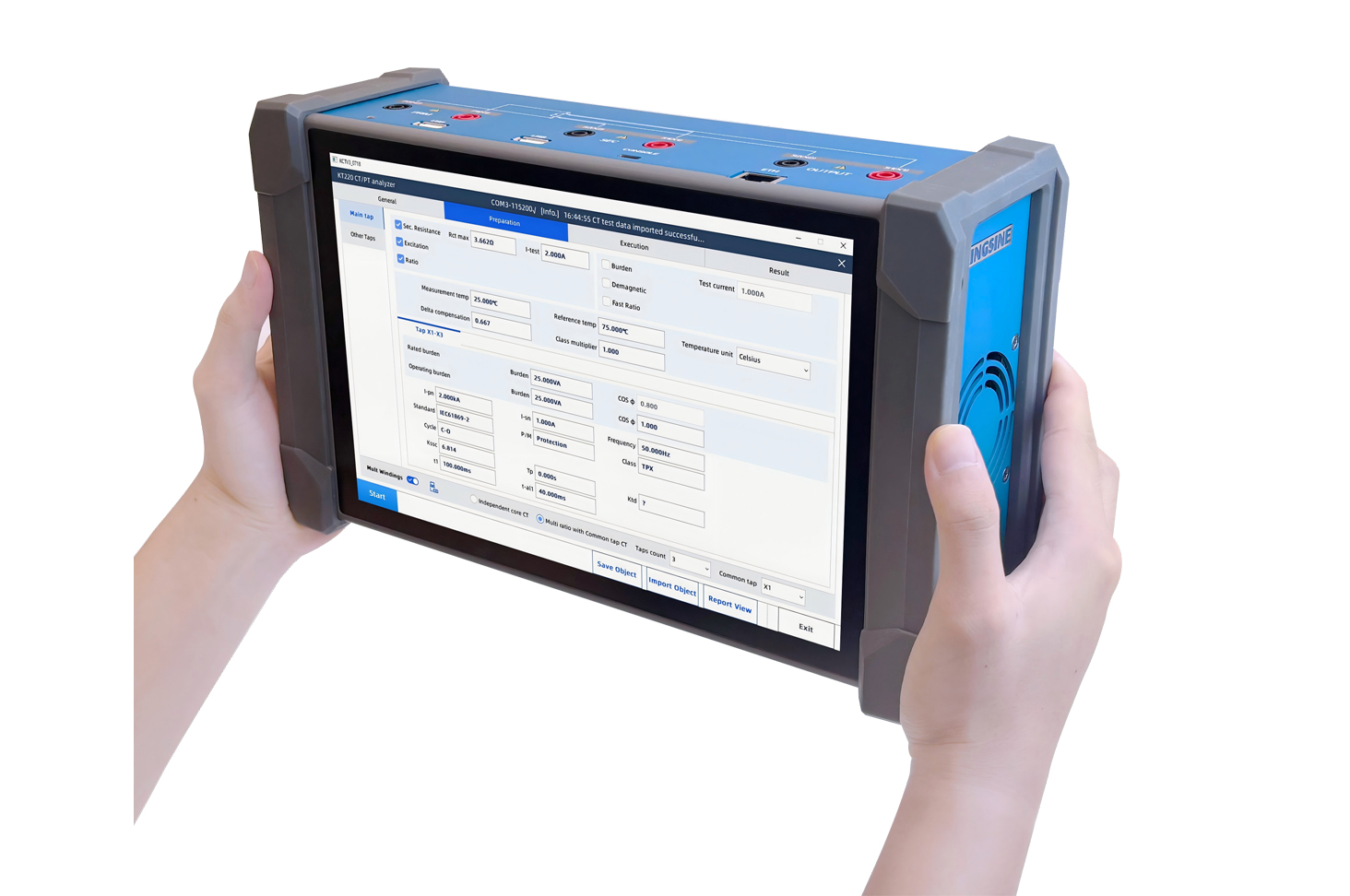
With the launch of KINGSINE’s new-generation 6-phase handheld protection relay tester KFA320, many customers have raised questions about the built-in battery — such as battery lifespan and battery maintenance. This article provides a clear explanation of all common battery-related topics for KINGSINE testers.
Battery Lifespan
The “lifespan” of a battery is typically evaluated from two perspectives: cycle life and calendar life.
1) Cycle Life
Definition:
The number of full charge — discharge cycles a battery can complete before its capacity drops to a certain percentage of its original value (commonly 80%).
A “cycle” does not mean charging once, but rather consuming a total of 100% of the battery’s capacity.
Example:
These add up to one full cycle.
Cycle life of KFA320/KFA310 lithium batteries: Designed for 300–500 cycles (while maintaining over 80% capacity).
2) Calendar Life
Definition:
The natural aging of the battery over time from the day it is manufactured — regardless of whether it is used frequently, rarely, or not at all.
Calendar life of KFA320/KFA310 lithium batteries: Generally 3–5 years.
Even with very few cycles, the internal chemical components gradually age, electrolyte decomposes, internal resistance increases, and capacity slowly decreases.
Main Factors Affecting Battery Life
Depth of Charge & Discharge:
Frequent deep discharges (down to 0%) or long periods at 100% charge significantly accelerate aging.
Temperature:
High temperature is the biggest threat. Using or storing batteries at temperatures above 35°C speeds up chemical reactions and causes rapid capacity loss.
Low temperatures mainly affect discharge performance (making the battery feel less durable), but the resulting capacity loss is typically reversible.
Fast Charging:
High-current fast charging generates more heat and may stress the battery more than slow charging.
Storage State (Full/Empty):
Storing the battery fully charged or fully depleted for long periods accelerates degradation.
Long-term Inactivity:
Not charging or discharging the battery for a long time also affects its lifespan.
It is recommended to perform a small charge – discharge cycle at least once every 3 months to maintain battery activity.
To improve product reliability and support easy maintenance, our testers not only adopt a plug-and-play design, but the battery itself is also removable, allowing convenient replacement and upkeep.
Battery Usage and Charge/Discharge Specifications
KFA320 Protection Relay Tester
Charging:
Discharge Performance (Room Temperature):
Full charge → 1%
3-phase positive sequence, each phase 5A
2.5 m, 2.5 mm² short-circuit test leads
Discharge time: 03:05:27
Full charge → 1%
3-phase positive sequence, each phase 10A
2.5 m, 2.5 mm² short-circuit test leads
Discharge time: 01:32:25
KFA310 Protection Relay Tester
Charging:
Discharge Performance (Room Temperature):
Full charge → 1%
3-phase positive sequence, each phase 5A
2.5 m, 2.5 mm² short-circuit test leads
Discharge time: 02:20:13
Full charge → 1%
3-phase positive sequence, each phase 10A
2.5 m, 2.5 mm² short-circuit test leads
Discharge time: 01:18:16
 English
  日本語
日本語  français
  Deutsch
  Español
  italiano
  русский
  português
  العربية
  Polska